

Turn Any Real-World Space Into a Robot Training Ground For Free
2026-07-17
Today we are announcing a new capability that connects everything we have been building directly to the robotics world: free USDZ export.
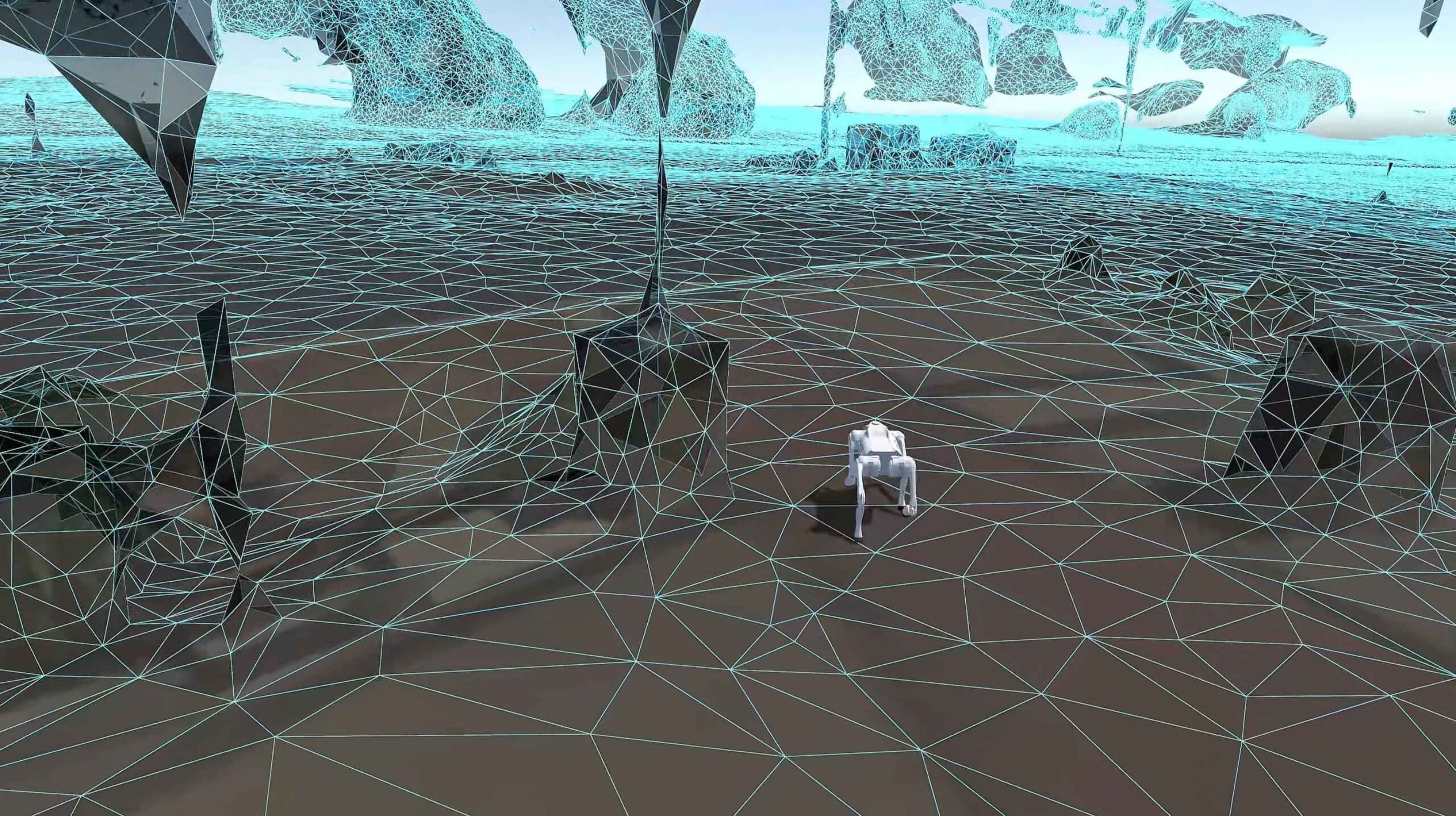
Starting now, anyone can capture a real-world space with a smartphone or a 360 camera, and download it as a metric-scaled, simulation-ready USDZ file, containing both a photorealistic 3D Gaussian splat and a collision-ready mesh, ready to be imported into NVIDIA Isaac Sim.
No LiDAR rig. No enterprise sales call. No waiting list. Capture, upload, download, simulate.
One File, Two Representations, True Scale
Every capture processed through OVER can now be exported as a single USDZ file that packages:
- A high-fidelity 3D Gaussian splat : the robot’s eyes. It renders photorealistic RGB from any viewpoint, reproducing the real lighting, textures, reflections, and clutter of the original space
- A collision mesh derived directly from the splat : the robot’s body. It gives the physics engine the geometry it needs for contact, navigation, and manipulation
- True metric scale : one meter in the real world is one meter in the simulation
Because the mesh is generated from the same reconstruction as the splat, the two representations are always aligned. There is no manual registration step, no scale guessing, and no drift between what the robot sees and what the physics engine computes. Import the file into Isaac Sim and the environment simply works.
This pairing is what makes the asset unique. Inside a single environment, a robot can physically interact with the scene through the collision mesh while its perception stack is fed photorealistic RGB rendered from the splat, the same kind of visual input its onboard cameras will receive in the real world. That closes the loop for vision-based policies: act, collide, observe, repeat, with both the physics and the pixels grounded in the same real place.
Why This Matters for Robotics
Anyone training robots today knows the problem: the sim-to-real gap. Policies trained in clean, synthetic environments consistently struggle when deployed in the messy real world, because synthetic scenes lack the visual richness reality provides, imperfect lighting, worn surfaces, reflections, and clutter.
The best way to close that gap is to train in a faithful digital twin of the environment where the robot will actually operate. Until now, producing that twin meant expensive RGB-LiDAR rigs, specialized survey teams, and budgets that only large labs could justify.
With free USDZ export, the capture device becomes the smartphone already in your pocket, or a consumer 360 camera. Walk through a warehouse, a retail floor, a street, or a lab. A few minutes later, that exact space is a training environment, with correct distances, correct proportions, and real-world visual complexity that synthetic assets can’t replicate.
How It Works
1. Capture the space with your smartphone or a 360 camera through the OVER app: https://link.ovr.ai/map2earn
2. Upload your footage and let the OVER pipeline reconstruct the scene, Gaussian splat, collision mesh, metric scale, packaged as one USDZ
3. Download your USDZ file
4. Import into NVIDIA Isaac Sim or Isaac Lab, and start training
It’s completely free. And because captures on OVER feed the map2earn™ program, the same walk that builds your simulation environment can also earn you rewards.
The same export capability is also planned for https://www.freegaussian.ai/, bringing simulation-ready output to browser-based reconstructions.
From Map2Earn™ to Physical AI Infrastructure
For our community, this launch means something bigger.
For years, the OVER community has been mapping the world through map2earn™, producing what is now more than 270,000 mappings and over 105 million images of real-world locations, a dataset already licensed by one of the world’s most valuable companies to train next-generation vision models.
USDZ export makes the value of that activity tangible in a whole new industry. Every scene captured by a mapper isn’t just AR real estate or VPS coverage anymore. It’s potential training infrastructure for Physical AI, the environments where tomorrow’s robots will learn to see, navigate, and act.
This is the DePIN flywheel we described in our 2026 roadmap, turning: robotics companies need real-world environments at scale; our community can capture them with devices they already own; and the demand flows back into the ecosystem that produced the data. Mappers earn. Robots learn.
The World Is the Best Training Ground
Our mission has always been to make the physical world machine-readable, first for people, through AR and navigation, and now for machines, through robotics simulation.
The industry is converging on USDZ and OpenUSD as the interchange format for simulation, and NVIDIA Isaac Sim has become the reference platform for training embodied AI. With today’s launch, the bridge between a real place and a robot’s training environment is a five-minute capture and a free download.
You can try it now in the OVER app https://link.ovr.ai/map2earn or on the web https://marketplace.ovr.ai/mappings
Join the conversation on Discord, and if you’re a robotics team looking for environment datasets at scale, reach out at business@ovr.ai.